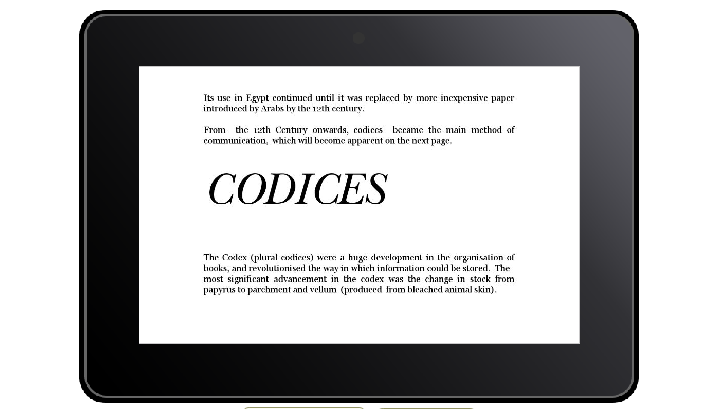
In order to find
out more about the Kindle, I emailed an author / Kindle owner. I wanted to ask
someone who is obsessed with reading, as obviously converting from physical
books to a Kindle would be a much larger step than just a light reader.
I also added my only comments afterwards to aid my project, These are shown in red.
Questions and Responses:
Hi Joe
I'll construct my answer in line with your questions, following your numbers.
1. Have you loved reading books your whole life?
I've always loved reading. My earliest memory is feeling rage towards my sister, a year older, because she could read and I still couldn't . (The idea of reading have a sentimental value)This was before either of us had started schools so I suppose I was 3. I've always collected reading material; (Something that cannot be done with a Kindle)when I was young I used to help my mother at jumble sales in return for books. Later in life, when I was attending lots of jumble sales myself, I used them to collect lots of books. I'm interested in lots of things and so bought lots of reference books - I have a fine collection of language dictionaries, all rendered completely unnecessary by the rise of Google Translate of course. The complex interplay between IT and reading is something I've considered a lot and will mention here a few times. Since I've retired I've been able to read more and so have done. I wrote a lot for a living, but obviously all of it was factual and technical, and perhaps as a response to that I read less factual matter now and correspondingly more fiction. I read for two or three hours a day, and always have, nearer three hours than two since I retired.
2. Is your love for books at its peak now, and if not, when was it?
To answer precisely your question - my love for books is not at it's peak now; it was at it's peak after I retired, but before I bought my Kindle. (Kindles have not affected his want to read)
3. Roughly how many books would you say you own?
Thanks to the remarkable librarything.com, where I have assiduously registered all the books in my house here in Welwyn Garden City, I can tell you with confidence that there are 1,762 books - a stack 199.3 feet high or requiring 60.8 metres of shelving. But that's only in my house here; in my house in France I've got lots more that I haven't yet submitted to librarything.com 's tender mercies. I reckon there's a similar number there, so maybe 0.29 of the Earth's circumference if all the pages were laid end to end. The oldest is part of the incunabula - those books printed before 1501 - and the newest was printed this month, April 2013.(He still buys physical books)
4. Do you favour any specific type of book? eg. Hardback, Softback, Clothbound, Sleeved books?
I'm too keen on buying stories and written works to be catholic in my tastes. For my collections (Everything by Richmal Crompton, both the 49 books that aren't about William and the 39 that are; and everything by Anthony Burgess, not only A Clockwork Orange) I paradoxically prefer books without jackets, because they are cheaper and more plentiful. I used to organise my books by the colour of their spine, so that used to be important to me but now isn't.
5. What general qualities of a book do you prefer over the Kindle? (To do with the senses)
Like everybody I prefer the look and smell of old, leather bound books; (Possibly a way of binding my book) however I have no more difficulty separating that from my liking of digital media than I do from separating my liking the look and smell of old churches from my atheism. Apart from leather bound books I like the look of early 20th century children's books because of their innovative typography, and the look of 1930's art deco influenced jackets. I also like the imagery used between the wars on jackets of what would now be called science fiction. Apart from those books produced under the paper-saving strictures of the Second World War, older books tend to have thicker pages than newer books, which sounder nicer when they turn. (I could use high GSM stock?)But let's face it, any sound can be sampled, and if the sound was that good then Amazon would already have made the page turns on a Kindle sound the same. Also, I think anybody bemoaning the decline of books should consider that exactly the same tired dull platitudes were being used to bore people a thousand years ago, by folk who loved their dear old scrolls and thought that these new-fangled books would never be as good as long rolls of dried out sedgewood pith.
6. Is there any difference in the reading experience?
The differences are many and varied, and all weigh in favour of the Kindle. Books are doggedly serial; printed character follows printed character, word follows word, chapter follows chapter. (My book could illustrate that books don't necessarily have to work in this order)Now for novels this is no bad thing - stories are a serial medium and always have been, since before writing let alone books. Stories of the cinematic variety on VHS tape didn't suffer from being on that serial medium, and correspondingly don't gain from being on a non-serial medium such as a disk - again, because stories are serial. However, stories do benefit from being on the non-serial Kindle, because of the beautiful Kindle design that links every word to it's corresponding dictionary entry. I wouldn't recommend reading an Anthony Burgess novel on paper, because he liked to write for people who were as well read as he: nobody is. So the reading experience on a Kindle is incomparably better when reading something with unusual words in it. Leaving aside novels for a second, the necessary seriality of books is most odious in non-fiction. It means that all sorts of dreadful workarounds are required; indices, bibliographies, lists of chapters, tables of contents, and other drudgery that darkens the soul of the reader. All of these are accepted and even praised by serious-minded literary critics - because they can't see how life-enhancing a bit of computerisation (and most especially hyperlinking) can be. Once a non-fiction work loses its corset of paper and therefore seriality, it can breath. The reader can find their way from any point to any related point, just as they can do when traversing the Web, and by precisely the same method. Moving on to more physical differences, the most important difference for me is weight. My Kindle weighs 240 grams; this is less than the average weight of my books, yet it's 4Gb of storage allows me to carry 3,500 stories within it - which by coincidence is roughly how many books I own. The Kindle's built-in dictionary is an electronic copy of a book that by itself weighs four times as much as the Kindle. Staying with physicality, most Kindles present words on a pleasingly opalescent background, rather than the harsher white of paper. This is easier on the eye, especially with the built-in LED light in the Amazon-supplied (and ridiculously expensive) cover, because it means no other light source is required, so it can be read anywhere, such as on a ferry surrounded by sleepers, or in bed next to a sleeping partner, or without the light in bright sunshine where a book's paper would glare. For those with poor memories who like to mark passages (or those forced by their education-provider to do the same for later regurgitation at examinations), a Kindle again prevails over any book, because the design allows such marking to be carried out (and shared online if desired) without any physical mark being made.
7. Do you have any specific examples of books which hold qualities that a Kindle could not possess? (Such as the way it is printed, or anything which is not related to simply the content)
My small part of the incunabula has the quality of age (if age is a quality).(A book that holds it's place in history) Apart from that, because my Kindle is constrained to 16 greyscales, any written work requiring colour will have qualities denied to it's Kindle incarnation. Since I haven't read a story with pictures since I went to school, it's no big loss. However, colour is often essential in a non-fiction work, such as a reference work (have you noticed how scanty our store of words is for dealing with the content of a book, not the physicality of the book itself? We tend to write 'book' when we mean 'the content of the book', because until recently there was little difference, and what difference there was didn't matter. That's so different now. I think of the difference in IT terms. The source of a program is as different from the instantiation of that program after compilation or interpretation as is a book and the story that it contains. The story lives in our head, the program in RAM. A running program shares almost nothing in common with its source, as a story in your head shares almost nothing with the place it came from, whether that be a film, book, audiobook, Kindle, or a story-teller in a street market in Addis Ababa. A similar difference is between the printed text of a play, and seeing that play performed). So colour is a good example of reference books and children's books having qualities not available to my Kindle. This of course is not the case with later Kindles, which have eschewed e-ink and so can display colours. I suppose it would be possible to produce a book where the depth of impression made by the printing process on the paper in some way conveyed meaning, and then this would be another quality unavailable on the Kindle, but I've never heard of this being used in printing. In fact, if you think about the 500 years head start that printers had over producers of electronic books, they really didn't do much that was original or artistic or worthy of admiration for it's design. I mean, in a tenth of that time we went from manned flight to setting foot on the moon; printers after half a millennium managed to invent offset lithography. An unimpressive bunch to say the least, only slightly in front of the creepy folk who hang around authors and who call themselves 'publishers'.
8. Do you own a Kindle, and if so, why did you chose to buy it?
You'll have guessed the answer to the the first part of this question by my previous answers, which you'll be pleased to know I won't repeat. I chose to buy it for reasons unrelated to the reasons why I now like it so much. I could see that the brutal way that publishers let interesting and important works go 'out of print' would not apply in the electronic world, and so I wanted to be able to read such works. I volunteer for a group called Distributed Proofreaders at www.pgdp.net who proofread out of copyright books for free electronic distribution by Project Gutenberg, to this end. There's a very close parallel with music here, where previously 'deleted' music is now available to everyone for ever thanks to computers, the internet, and mp3 players; the latter are to 78s what Kindles are to books; that is, immeasurably better in every conceivable way.
9. Do you know any other book lovers who have bought Kindles?
All the people I know who love reading now own Kindles. I know this isn't an answer to your question, but I do think that the people who thought that they loved books and then buy Kindles soon find out for themselves the difference between stories and their paper containers, as I mentioned at tiresome length in my diatribe on the paucity of words to make this differentiation at Question 7 above.
10. In your opinion, do you think E - Books are destroying the publishing industry?
I would love them to do so. However, the publishing industry is full of whiners who will browbeat borderline corrupt politicians into imposing daft strictures on electronic book publishers because they know their own industry has the longevity of manufacturers of servants' hats. Although this will prop them up for a while, these strictures will be as successful in the long term at stopping people enjoying stories presented electronically as imposing a tariff on cassette tapes is today at stopping people enjoying music electronically. If the publishing industry wasn't composed entirely of shrill dullards, it would see that publishing's USP is proofreading. Nothing else that publishers do has any worth or relevance. For unequivocal evidence of the need for proofreading, see any self-published story. The fact that self-published stories are so easy to find gives the lie to the publishers' tales of their being required to publicise new stories. Actually, that's what Twitter is for. All the other things that publishers do - frantically copy whatever sold well last year, give huge advances to C-list actresses, wring their hands about Amazon - are really not helpful. We won't miss publishers when they're gone.
I've attached a few photos of my books Joe. Not sure if you want to be able to see the actual books, or the books in their setting, so I've done the latter. let me know if you'd prefer anything else. I've got to say, they are better organised on my Kindle...
All the best
Attached Photos: